What an interesting Spring we have had here in Missouri. It seemed as though Spring just would not get here and stay with us! Of course, this means the start to nesting season has been very different than last season. This time last year many of us had eggs hatching. This year it seems some of you have eggs hatching while others have birds just now selecting a box and putting in nesting material! Who knows what the rest of the season holds. I can tell you, however, about a few things sure to be helpful to all bluebird- ers: Please take a few minutes to look over the information in our newsletter on the new “House Sparrow Project” . I am sure many of you could provide valuable information to this study. Also, Please be sure to note the information Steve Smith has submitted on the upcoming MOBS Field Trip in June. I know I plan to be there and am sure I will learn a lot. Of course, you’ll also want to hurry and send in your Registration for the 2013 Missouri Bluebird Conference (July 12-14th). There will be so much to discover at this years conference to benefit all of us AND our native cavity nesters. Plus, the gorgeous Powell Gardens is a terrific setting and the planned field trips and programs are sure to provide valuable data, great experience, and wonderful camaraderie with other Bluebirders!
Do what you can to help the Bluebirds,
Steve Garr,
MOBS president
Letter from the President
May 1, 2013
 Leave a Comment » |
  Uncategorized |
  Permalink
 Posted by missouribluebird
Wintertime Nest Box Monitoring
January 27, 2013By Steve Garr, MOBS President
Have you checked your nest boxes since removing the last nesting material of the season? If not, there are plenty of reasons to do so. At the top of my list: to keep House Sparrows from taking up residence in the boxes in the winter.
Most of us who have been bluebirding and raising other native birds in our nest boxes for any length of time have had the great pleasure of knowing some of our boxes will often be used by bluebirds in colder months to roost in at night and stay warm. While I have seen a dozen or more Bluebirds pile into one nest box at night, friends have described scenes in their yards of 20 or more bluebirds roosting in nest boxes. Most information regarding House Sparrows using nest boxes to roost in the winter indicate there is seldom more than one bird per box. This has been my observation as well. This observation might lead some folks to the opinion that since it is “only one House Sparrow” it doesn’t really make much difference to let it stay. I could not disagree more. For starters, that one non-native House Sparrow is taking winter shelter from other native birds (and in the case of bluebirds possibly several native birds at once). But equally as important is the degree to which a House Sparrow will “bond” to a nest box, even in winter, causing it to defend the box even more rigorously in the spring. Basically, we are empowering our bluebird’s competition when we allow House Sparrows to over-winter in our nest boxes. Naturally, we don’t want to do that after making so many good efforts to assist the bluebirds.
In many parts of North America this issue of House Sparrows claiming boxes in the off-season could be of particular importance this year. So many areas experienced a mild and even rather warm Fall. In the area of Missouri in which I live, I believe very warm , summer-like weather contributed to the fact that House Sparrows began putting nest material in my nest boxes in Fall and even as recently as mid December. A recent check of four nest boxes in my small yard produced three House Sparrow nest starts. House Sparrows had also attempted to nest in boxes on my trails- boxes which I had cleaned out for the season after bluebirds had successfully nested this past season. So, again, if you have not looked inside your nest boxes since removing the final nest material from last year, I strongly suggest you do so. And then continue to monitor your nest boxes throughout the winter months. What to do in the event you find a House Sparrow already committed to one of your boxes? I have some tips.
Steps to discouraging House Sparrows from residing in nest boxes in winter:
1. Simply disturbing the bird in the box during the night is a great start. It may be several days before this bird returns. Birds have a tendency to continue to roost in location where they feel safe, so by disturbing them in the middle of the night they no longer feel safe and that location becomes a dangerous location.
2. Place a live-trap in the nest box in the afternoon if you have observed a House sparrow at the box. Place a small piece of grass over the entrance hole to use as an indicator to whether or not a bird has entered the box.
(“Wintertime Monitoring” continued from page 2) Check the box every 30 minutes for bird activity. Remove the trap after your final check for the night and do not leave the trap inside the box over night.
3. If you believe a House Sparrow has roosted in a nest box for the evening, place a clear plastic bag over the entire nest box or over the entrance hole. (Do this after sunset). Tap on the side of the box to try to get the bird to exit the box into the bag. Sometimes you have to partially open the door and slide a small stick around the inside of the nest box to encourage the bird to exit the nest box into the bag. A clear bag is recommended so you can identify the bird in case a native bird had taken over the nest box.
Each year I get inquiries about Bluebirds and Purple Martins. Sometimes the questions may be concerning why folks are getting less Bluebirds each year and more House Sparrows. Or, “Why aren’t my Purple Martins keeping the House Sparrows away from their martin house?”. The answer is the same for both the Bluebirds and the Purple Martins. When a non-native bird that is more aggressive and is determined to kill (not to just chase) the native bird away from the cavity, the more aggressive bird usually wins. Bluebirds and Purple Martins need our help to defeat the House Sparrow. One way we can get a head start on helping our native birds during nesting season is to keep their nest sites free of House Sparrows now.
Take time to help you bluebirds.
Steve
Leave a Comment » | Uncategorized | Permalink
Posted by missouribluebird
MOBS Field Trip to member Ivan Ray Miller’s home
August 5, 2012by Steve Smith, MOBS Board Member
First I’d like to say thank you to Ivan Ray for allowing us a to take a glimpse into his life and to visit with his wonderful family Anna Mae, Nelson Ray and Esther Sue.
What a GREAT first field trip for MOBS. The turnout was fantastic with 36 in attendance including the Miller Family. We met at Ivan’s home in Jamesport, MO on July 28, 2012 and started the field trip at 10am with a walk around the home and through the gardens. Ivan had a nesting pair of Northern Flickers in his Flicker box that fledged 6 for the first time since he put the box up a few years back. As we walked to the Purple Martin colony we also spotted a Blue Grosbeak nest in one of the peach trees. The Purple Martin colony had almost all moved on but a few were still present for us to observe. Next Ivan had a surprise in store for the group. He had 2 teams of horses hitched to hay wagons ready to take us to his Bluebird trail and pond and to view the acreage he is returning back to prime wildlife habitat.
While we were on our hayride, Anna Mae and Esther Sue were back at the house preparing a wonderful lunch for everyone that included homemade pie and ice cream. They opened their home to us and gave us all a chance to relax and converse about all that we had seen so far. Regarding the homemade pie and ice cream…all I can say is YUM!!
After lunch we all loaded into our cars and drove to Little Indian Lake Conservation area to view Ivan’s more than 49 Prothonatory Warbler nesting boxes. Very impressive indeed. While there, MOBS board member Jim Rathert spotted an Eastern Kingbird nest with one nestling almost ready to fledge. He flapped his wings several times, the nestling not Jim, but decided he just wasn’t ready to leave the nest. Both adults were close by.
All in all it was a great day of birding so thanks again to Ivan and his family for their hospitality.
[slideshow]
1 Comment | Uncategorized | Permalink
Posted by missouribluebird
Letter from MOBS President Steve Garr
July 22, 2012Dear Bluebird Enthusiasts,
What a terrific Bluebird Conference! I want to personally thank everyone in attendance, all of the terrific speakers, the field trip leaders and the board members and Society members who all pitched in and took responsibility for various aspects of the conference. Great job!
We had 85 folks in attendance coming from eight different states and one Canadian province! We set records for both total attendance AND number of states/provinces represented. We also had a terrific showing from Missouri bluebirders all across the state. One of the best things about a bluebird conference is the networking and sharing of ideas with other bluebirders. This Conference certainly had a lot of that going on! With such a diverse group we were all bound to learn something.
Another important feature of this conference was the fact that it pulled together so many dedicated Conservation organizations. After all, our efforts with native-cavity nesters are just a part of a larger conservation picture. Brad Jacobs represented our own wonderful Missouri Department of Conservation, but we also had representatives from the North American Bluebird Society, Bluebirds Across Nebraska, and the wonderful (and supportive) folks from the Missouri River Bird Observatory.
Brad Jacob’s program, highlighting the importance of Bird Conservation on wintering grounds, revealed just how tuned in Missouri is to Conservation outreach which ultimately benefits Missouri wildlife. It was so great to see long-time friend Dr. David Pitts and his family and to get to hear David present his wonderful research again. Forty years of studying Eastern Bluebirds- what a wealth of knowledge he is! We received many positive comments about the program by Missouri Master Gardener Kris Leech. Kris, like most of us, has a special affinity for gardening with wildlife in mind. She gave us lots to think about as we arrange our yards and gardens to be “home” to everything from hummers to frogs to foxes- and bluebirds of course. And a new friend, Rich Stanton, presented an intriguing program about the possible reintroduction of Brown-headed nuthatches into Missouri. Rich and others have invested an impressive amount of time and work into gathering data related to this topic. I particularly appreciated how Rich detailed the steps by which a species is re-introduced into an area – and since the Missouri Bluebird Society is concerned about all native cavity – nesters , it was great to see such concern for this small but quite special primary cavity-nester.
One of the highlights for me at the conference was getting to see the “Bluebirds & Friends” slide show featuring YOUR bluebird photos . It was great to see the pictures our members sent in of the birds in their yards and trails , set to music, and on the “big screen”. This is a tradition I hope MOBS will continue. Thanks to everyone who emailed us pictures of your birds and trails.
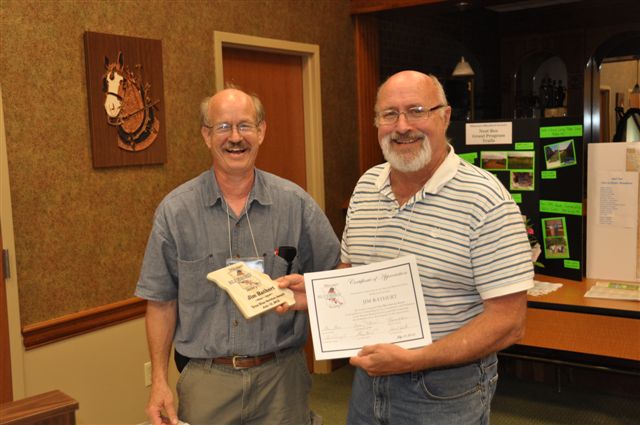
For those who were unable to attend the Bluebird Banquet on Friday evening, I have included here a photo of the very deserving Jim Rathert receiving the Society’s first ever “True Blue Service Award”. Jim has been a faithful charter member, charter Board Member, and supporter of MOBS since it’s inception in 2006. He played a very important role in the establishment of the Missouri Bluebird Society when he first accepted responsibility as a Board member, and he’s been supporting MOBS with his actions and hard work ever since. Thank you Jim!
I am certainly looking forward to the next Missouri Bluebird Conference at Powell Gardens July 13, 2013! However, we do have some wonderful get–to-gathers planned before then so Keep an eye on The Fledgling newsletter and on the website .
I look forward to seeing you soon and I thank you for all you do for the Bluebirds!
Steve Garr
Missouri Bluebird Society
President
[slideshow]
Leave a Comment » | 2012 Conference | Permalink
Posted by missouribluebird
2012 Missouri Bluebird Society Conference Registration Form and Information
June 21, 2012Click here for the 2012 Missouri Bluebird Society Registration Form.
Leave a Comment » | 2012 Conference | Permalink
Posted by missouribluebird
2012 Summer Missouri Bluebird Conference
February 21, 2012This year’s conference brings us back to Jefferson City, Missouri July 13-15, 2012. The Conference Speaker Programs will be held on Sat. July 14th in the Clydesdale Room of N.H. Schepper’s Distributing Company located at 2300 Saint Marys Blvd.
We have four fantastic program speakers scheduled to present some new and interesting topics.
Brad Jacobs: Missouri Department of Conservation and author of Birds in Missouri
T. David Pitts: author of Studying Eastern Bluebirds: A Biologist’s Report and Reflections
Kris Leech: Missouri Master Gardener presenting a program on Gardening for Wildlife
Rich Stanton: University of Missouri, researching the possible reintroduction of Brown- headed Nuthatches to Missouri.
The conference will also feature Field Trips, Terrific Food, and a Friday evening Social!
Click here for additional information.
Leave a Comment » | 2012 Conference | Permalink
Posted by missouribluebird
2011 Conference Brings Accolades to Steve & Regina Garr
November 9, 2010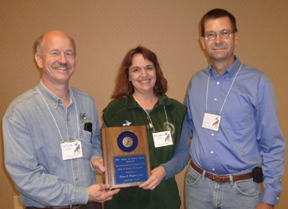
Steve and Regina Garr of Jefferson City, Missouri were presented with the John and Nora Lane Award from NABS for outstanding work in the field of Bluebird Conservation. Longtime NABS member Ron Kingston received the award on their behalf in Jackson. Greg Beavers, NABS Treasurer, presented the award to the Garrs at the Missouri Bluebird Conference on October 1. Steve Garr has worked tirelessly since 1979 educating the public through his newspaper columns, magazine articles, television appearances, and personal appearances at various conferences and events on how to help the bluebird. He personally erected and monitored many nestbox trails in both Tennessee and Missouri. He co-founded two NABS Affiliates: Tennessee Bluebird Trails (2000) and the Missouri Bluebird Society (2006). Besides doing field work, Steve volunteered for NABS by serving on the Board of Directors and as Vice President and President (2000–2006). Regina Garr has been an enthusiastic partner in all of his conservation work, helping spread the bluebird conservation message. Even though Steve has had a Life Membership in NABS for decades, he continues to support NABS with additional Corporate memberships. He and Regina have donated NABS memberships for door prizes at countless seminars on bluebird conservation — giving many people their start in an association with NABS and organized bluebird conservation. Steve and Regina Garr continue to promote bluebird conservation on all fronts: education, in the field, and in leadership roles in the organizations that promote bluebird conservation.
The John and Nora Lane Award was created to honor Canadian conservationists John and Norah Lane, who were among the first people to sound the alarm about declining bluebird populations. The Lanes’ bluebird trail consisted of 4,750 nestboxes and stretched almost 2,500 miles.
Reprint with permission from winter edition of NABS Bluebird. Photo by Jim Rathert.
Leave a Comment » | 2011 Conference | Permalink
Posted by missouribluebird
My Favorite Bluebird Website
November 17, 2009By Jack Dodson

May all your blues be birds!
– Bet Zimmerman
Some day, perhaps it will be this website, but for now my favorite site is www.sialis.org which is managed by Bet Zimmerman.
This is the most complete and well organized site that I have found. I strongly suggest that you all check it out.
1 Comment | Bluebird Websites | Permalink
Posted by missouribluebird
Missouri Bluebird Society Nest Box Grant Program
July 3, 2009
Gilbertson style PVC
The Missouri Bluebird Society is a 501(c) 3 not- for- profit organization dedicated to conservation of bluebirds and other native cavity nesting songbirds, and to educational projects that would be of benefit to these native birds. A limited number of nest boxes each year will be awarded to assist in projects that help promote the objective of the Missouri Bluebird Society (MOBS).
These projects must include establishing and enhancing nest box trails on public lands within the state
of Missouri, and have as one of its goals the education of the local community about Bluebirds and other

Gilwood style
native Cavity Nesting Species. These grants start at five sets of nest boxes and poles per grant, on a ?matching basis?, with MOBS providing five nest box/pole sets when applicant provides an equal number of nest box/ pole sets. Whether or not the matching box requirement can be met by refurbishing existing boxes on an established trail will be at the discretion of the MOBS
Board of Directors. Further, applicants must agree to the following provisions:
1. Applicant’s nest boxes must be constructed in a fashion and design recommended and approved by MOBS.
2. Trail Location must be approved by MOBS.
3. The applicant agrees to present a 15-30 minute program to their organization or another community organization about bluebirds and other native cavity –nesting birds and the need for monitored bluebird trails. MOBS will assist in providing materials for this presentation.
4. The applicant agrees to take responsibility for seeing that the nest box trail is adequately monitored and agrees to take all
necessary precautions and maintenance measures to ensure that non-native species are not allowed to

Slot Box
inhabit and reproduce in the nest boxes.
5.The applicant agrees to turn in a completed MOBS nest box monitoring form each year after nesting season reporting nesting activity on the trail.
Download the application for more information on the program.
1 Comment | Bird Boxes | Permalink
Posted by missouribluebird